
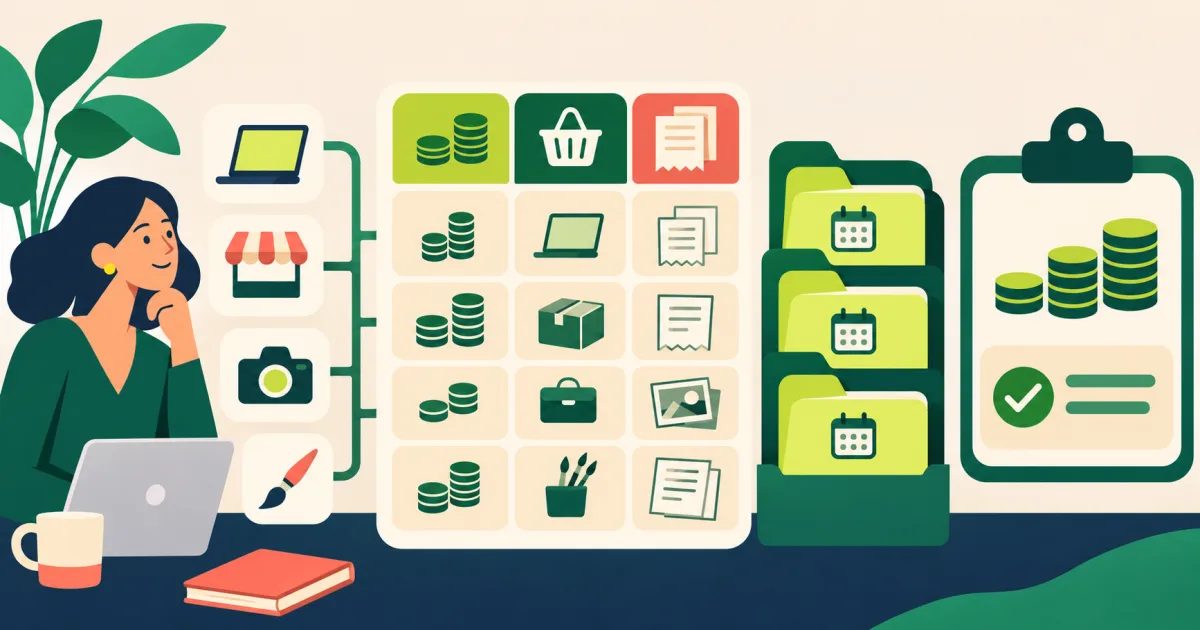
Side income should be classified before it is added to an annual tax worksheet. A bank deposit can be a customer payment, owner transfer, loan, refund or reimbursement. Build a source ledger that explains each receipt and connects genuine income to the work, invoice or agreement that created it.
Record gross before costs
Record gross receipts, refunds and business-related costs in separate columns. Netting fees before recording revenue can hide the true sales amount and make platform statements impossible to reconcile.
Separate sources and transfers
Use separate categories for freelance services, online sales, commission, rental and other activities. Mark personal transfers and loans so they are not counted as revenue. Keep the payer and purpose for every unfamiliar deposit.
| Record or input | What to verify |
|---|---|
| Source ledger | Payer, purpose and date |
| Gross receipt | Amount earned before fees |
| Cost record | Business purpose and evidence |
| Bank reconciliation | Deposits and transfers explained |
Source ledger
Payer, purpose and date. For How to Organise Side Income for Tax, use the source ledger beside the gross receipt to test record gross before costs. Keep its source, period and status visible when completing prepare the annual summary.
Gross receipt
Amount earned before fees. For How to Organise Side Income for Tax, use the gross receipt beside the cost record to test record gross before costs. Keep its source, period and status visible when completing prepare the annual summary.
Cost record
Business purpose and evidence. For How to Organise Side Income for Tax, use the cost record beside the bank reconciliation to test record gross before costs. Keep its source, period and status visible when completing prepare the annual summary.
Bank reconciliation
Deposits and transfers explained. For How to Organise Side Income for Tax, use the bank reconciliation beside the source ledger to test record gross before costs. Keep its source, period and status visible when completing prepare the annual summary.
Online work example
If a platform reports $12,000 of customer payments, retains $900 of fees and sends $11,100 to the bank, record $12,000 gross and $900 fee before considering tax treatment. The bank deposit alone does not show both sides.
Reserve without guessing liability
Set aside cash using a conservative planning percentage or estimator, but do not call the reserve final tax. Final treatment depends on classification, evidence, the complete year and current rules.
Prepare the annual summary
At year end, total each source, reconcile platform and bank records, list costs with evidence and connect the result to the appropriate filing workflow. Keep employment income separate until the annual tax calculation combines them.
Do not treat every deposit as income
In the How to Organise Side Income for Tax review, do not treat every deposit as income uses the source ledger to verify payer, purpose and date. Resolve the point against reserve without guessing liability and record the dated outcome.
Record gross and fees
In the How to Organise Side Income for Tax review, record gross and fees uses the gross receipt to verify amount earned before fees. Resolve the point against reserve without guessing liability and record the dated outcome.
Keep source categories
In the How to Organise Side Income for Tax review, keep source categories uses the cost record to verify business purpose and evidence. Resolve the point against reserve without guessing liability and record the dated outcome.
Reserve conservatively
In the How to Organise Side Income for Tax review, reserve conservatively uses the bank reconciliation to verify deposits and transfers explained. Resolve the point against reserve without guessing liability and record the dated outcome.
Where How to Organise Side Income for Tax fits in the income record
Side income feeds the multiple-income planner, annual tax estimate and recordkeeping guides. Continue the multiple income review through these exact calculation and record pages: multiple-income planner side-income tax reserve guide multiple-income hub.
Final evidence check for How to Organise Side Income for Tax
For How to Organise Side Income for Tax, the closing file connects source ledger, gross receipt, cost record, bank reconciliation. Complete Prepare the annual summary only after Record gross before costs explains the result and Reserve without guessing liability records what remains uncertain. Keep the dated working result separate from any later employer, agency or tax-authority figure.
Source boundary for How to Organise Side Income for Tax
For How to Organise Side Income for Tax, OECD Taxing Wages 2026 anchors the general concept rather than a local result. The relevant tax authority states that gains or profits from business, trade, vocation or profession can be liable to tax; classification requires the actual facts. Apply the FROM.MY verification method to the facts identified under reserve without guessing liability before acting.