
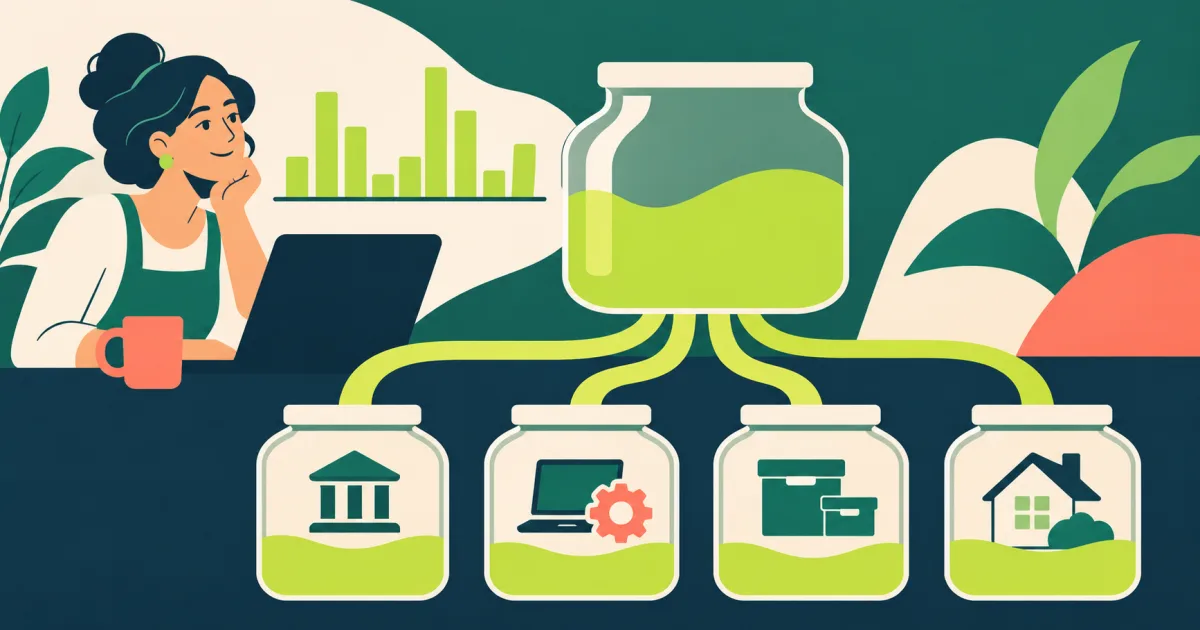
An irregular-income budget should smooth cash without pretending every month earns the average. Route receipts into a holding account, reserve known obligations and pay the household a conservative monthly draw. Review the draw from a trailing record and a downside scenario.
Choose a base draw
Use several months of cleared net cash and choose a draw that survives weak periods. A new business may need a lower temporary base until the record is long enough.
Review without chasing one good month
Review quarterly or after a material client change. Raise the draw only when recurring evidence supports it. Lower it early if forward work or collections weaken.
Budget from cleared cash
In the How to Budget With Irregular Income review, budget from cleared cash uses the monthly draw to verify stable household transfer. Resolve the point against use buffers with clear jobs and record the dated outcome.
Use a downside month
In the How to Budget With Irregular Income review, use a downside month uses the cleared receipts to verify cash actually collected. Resolve the point against use buffers with clear jobs and record the dated outcome.
Label every buffer
In the How to Budget With Irregular Income review, label every buffer uses the business obligations to verify costs and tax reserve. Resolve the point against use buffers with clear jobs and record the dated outcome.
Review quarterly
In the How to Budget With Irregular Income review, review quarterly uses the holding balance to verify income-smoothing cash. Resolve the point against use buffers with clear jobs and record the dated outcome.
Separate earning from spending
Record gross receipts, business costs, tax reserve and owner cash separately. Household spending begins with the transfer out, not with every client deposit.
- Cleared receipts: Cash actually collected
- Business obligations: Costs and tax reserve
- Holding balance: Income-smoothing cash
- Monthly draw: Stable household transfer
Cleared receipts
Cash actually collected. For How to Budget With Irregular Income, use the cleared receipts beside the business obligations to test choose a base draw. Keep its source, period and status visible when completing review without chasing one good month.
Business obligations
Costs and tax reserve. For How to Budget With Irregular Income, use the business obligations beside the holding balance to test choose a base draw. Keep its source, period and status visible when completing review without chasing one good month.
Holding balance
Income-smoothing cash. For How to Budget With Irregular Income, use the holding balance beside the monthly draw to test choose a base draw. Keep its source, period and status visible when completing review without chasing one good month.
Monthly draw
Stable household transfer. For How to Budget With Irregular Income, use the monthly draw beside the cleared receipts to test choose a base draw. Keep its source, period and status visible when completing review without chasing one good month.
Use buffers with clear jobs
Keep tax reserve, business operating buffer and household emergency fund separate. One large balance without labels can be accidentally spent twice in the plan.
Uneven-quarter example
If net available cash is $8,000, $3,000 and $5,000, a $5,333 average is not automatically safe. Test essential expenses against the low month and preserve part of stronger months in the holding balance.
Where How to Budget With Irregular Income fits in the income record
The budget connects income concentration, tax reserve and the multiple-income planner. Continue the multiple income review through these exact calculation and record pages: variable income budgeting guide multiple-income planner tax reserve guide.
Final evidence check for How to Budget With Irregular Income
For How to Budget With Irregular Income, the closing file connects cleared receipts, business obligations, holding balance, monthly draw. Complete Review without chasing one good month only after Choose a base draw explains the result and Use buffers with clear jobs records what remains uncertain. Keep the dated working result separate from any later employer, agency or tax-authority figure.
Source boundary for How to Budget With Irregular Income
For How to Budget With Irregular Income, OECD Taxing Wages 2026 anchors the general concept rather than a local result. The relevant tax authority controls tax obligations; the holding-account approach is a cash-management method, not a tax rule. Apply the FROM.MY verification method to the facts identified under use buffers with clear jobs before acting.